
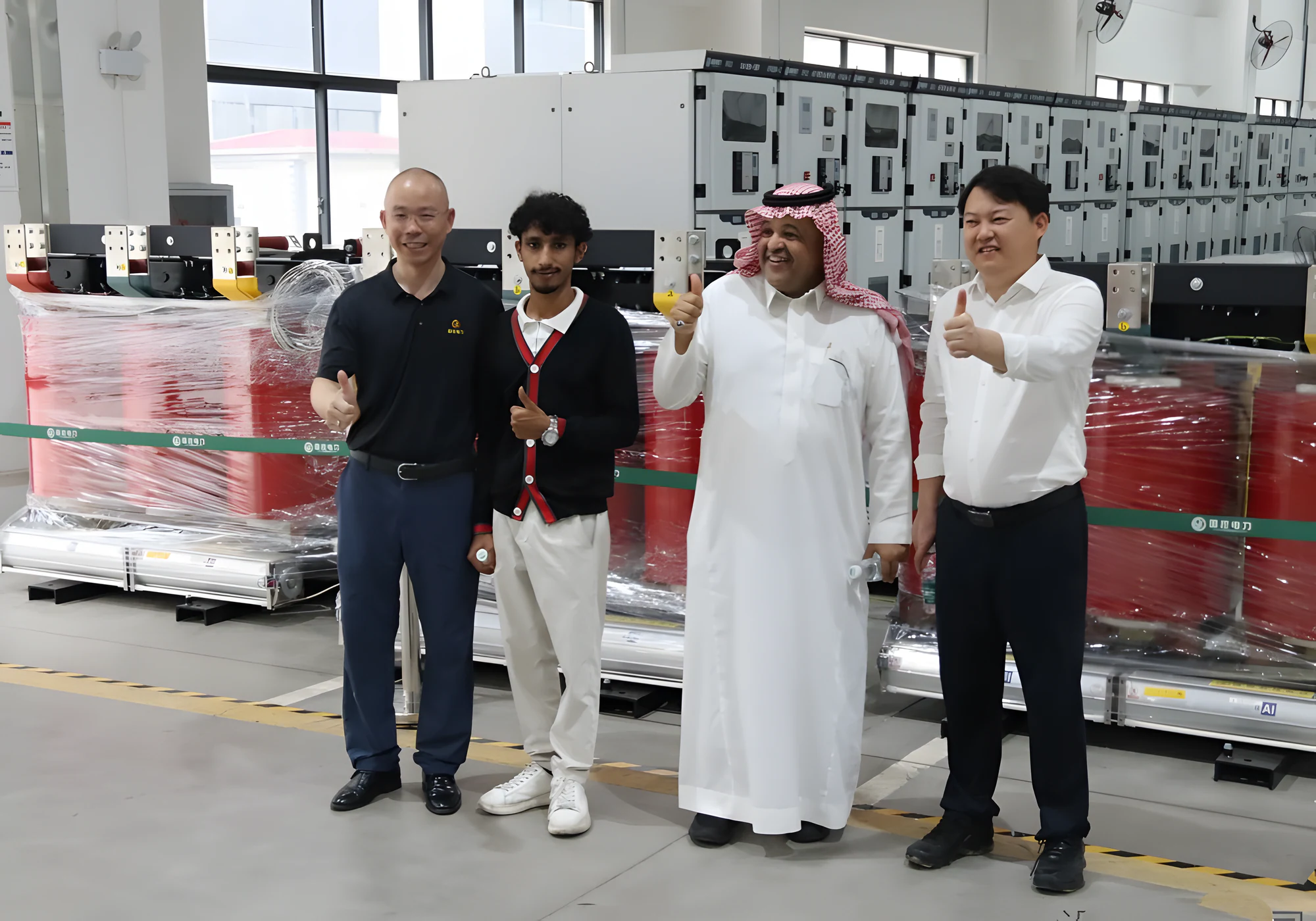

In the early days of heavy rains, outside the premises of Jiangsu Guokong Electric Power Equipment Co., Ltd., a crane is in operation, preparing to hang an 8-metre-long container transformer on a truck; dozens of workers in the workshop are on time for overtime orders from enterprises such as Nfei and Tyson in China.
This year marks the 11th anniversary of Jiangsu Guokong Electric Power Equipment Co., Ltd., and its sales reached RMB 175 million last year. Over years of development, its compact substations, high- and low-voltage distribution cabinets, user-side energy storage systems, compact busways, and industrial automation control equipment have earned strong recognition in China and been exported to Southeast Asia, Africa, and other markets. “Our overseas business paused at the start of the pandemic, but the impact was limited because our main market remains domestic,” Chairman Zhang Xiaofeng said. The pandemic sharply increased logistics costs, often causing challenges such as delayed deliveries and sales or technical personnel being unable to reach project sites. The company overcame these difficulties by flexibly switching suppliers and holding online meetings.
When the real estate market was hit in the second half of last year, State-controlled electricity began to reduce the scope of cooperation with real estate companies, “know that real estate companies used to be our big customer and that the electricity system of a small residential district was very substantial”. Zhang Xiaosai said it had been fortunate that, thanks to its price and technical advantages, the company had had a large number of high-quality customers in Chinese and Chinese, and had been successful in the construction of projects such as the Shenzhen Salt Field Power Plant, the expansion of Shengdong Airport, the iron-coated salt section of orbital traffic, and the Port Lu.
Over the years, Jiangsu Guokong Electric Power Equipment Co., Ltd. has been recognized as a National High-Tech Enterprise, a Nantong High-Growth Technology Enterprise, a Nantong Specialized and Innovative Technology Little Giant Enterprise, and one of Jiangsu Province's Most Promising High-Tech Enterprises for 2021. It holds four invention patents and 32 utility model patents. “On our own, we can make localized improvements and inventions, such as high-voltage temperature-control and cooling systems,” Zhang Xiaofeng said. He understands that breakthrough R&D also requires collaboration with universities.
At present, enterprises cooperate with universities of higher education, such as Shanghai Electricity University, Nantung University, and North China Electricity University in stable research in production, “We are working with Shanghai Electricity University to develop small high-pressure cabinets to meet the need for space savings from the intensive use of land”. Currently, fewer than 10 enterprises in the country own the patent, the market is less competitive and, if research and development succeeds, the gross profit margin can reach 45-50 per cent, more than three times that of common equipment.
As the new energy industry flourished, State-controlled electricity increased research and development of energy storage equipment. The energy cabinets developed by the company in partnership with a Suzhou enterprise have been approved by the China Quality Certification Centre as a standard cabinet, and work will begin next month on a pilot project in Central Cohaia, “The next step will be to work with a number of new energy companies, which will be responsible for software and partial hardware design, and we will be responsible for integration and assembly, working together in the new energy industry”.
The rented premises are full of materials and semi-finished products, and the working environment is somewhat inadequate. However, a completely new digital and intelligent plant, which belongs to state-controlled electricity, is under construction and is expected to be completed by the end of the year. “After moving in next year, the machine's arm will be available on a modern water line, and I have reserved a site for large storage containers of more than 20 metres long.” Zhang Xiaobing is ambitious.